
Quick Summary
Recovering from a property blaze requires full-spectrum fire damage restoration that addresses immediate structural hazards, concealed soot migration, and firefighting water damage. Floodline Restoration Co. delivers an integrated solution in Queens, managing every stage from emergency board-up and thermal soot removal to complete structural reconstruction without third-party handoffs. Property owners will understand the recovery process and can call Floodline Restoration Co. at their 24/7 live dispatch for an immediate emergency response and a free, no-obligation visual inspection.
Fire Damage Restoration: Repair and Recovery Guide
Note: This article is for informational purposes only. Fire-damaged properties should never be entered until the fire department or the appropriate local authority has determined that the structure is safe.[4]
A residential or commercial fire leaves behind complex damage. Beyond charred building materials, property owners face soot residues, airborne particulates, and water from firefighting efforts. Proper fire damage restoration requires careful mitigation followed by structural repair.
According to National Fire Protection Association (NFPA) U.S. home-fire data for 2019 through 2023, 68 percent of reported home fires occurred in one- or two-family homes. In this dataset, these fires accounted for 85 percent of civilian home fire deaths, 67 percent of civilian injuries, and 79 percent of direct property damage. While fire rates have declined substantially over recent decades, fire risks and outcomes vary across different types of residential structures and occupancies.[1]
Addressing fire damage restoration effectively involves understanding structural stabilization, safety requirements, and proper documentation for insurance evaluation, as specialists at Floodline Restoration Co. emphasize.
What Is the General Fire Damage Restoration Process?
Professional fire damage restoration involves a multi-step sequence to secure the property, remove contaminants, and return the building to a safe condition. The general supported process includes:
- Confirming safety before entry: Ensuring official authorization from fire authorities before anyone enters the structure.
- Securing the building and utilities: Boarding up broken windows, tarping damaged roofs, and shutting off or evaluating compromised electrical, gas, and water systems.
- Documenting damage: Taking comprehensive notes, photographs, and records of structural damage and impacted contents.
- Addressing firefighting-related water damage: Extracting standing water and drying saturated building assemblies to prevent further deterioration.
- Removing debris and damaged materials: Clearing out unsalvageable structural elements, charred drywall, and compromised insulation.
- Cleaning smoke and soot: Removing residue from surfaces using methods suited to the specific materials and soot characteristics.
- Restoring contents: Evaluating, cleaning, and deodorizing salvageable personal property where feasible.
- Repairing the structure: Rebuilding framing, utilities, drywall, and finishes to restore structural integrity.
Potential Concealed Smoke Damage in Shared Walls
In attached structures and buildings with shared party walls, smoke and hot gases can potentially migrate into wall cavities, floor joist pockets, and structural gaps. This may lead to hidden soot deposits and persistent odors behind plaster or drywall.
Whether smoke migration occurs depends on building construction, airflow paths, and the intensity of the fire. When concealed contamination is suspected, qualified professionals such as Floodline Restoration Co. evaluate wall cavities and determine whether selective opening, cleaning, or surface sealing is appropriate for the specific conditions.
What Factors Influence the Cost of Fire Damage Restoration?
Need fire damage restoration?
We’re available now - call for a fast, free estimate.
The total cost of fire damage restoration depends on the square footage affected, the structural depth of the fire, the volume of water used during suppression, and the specific materials involved. Property owners should obtain detailed, written estimates outlining the proposed scope of work before structural repairs begin.[5]
Primary Cost Factors
- Water Mitigation: Removing water and drying saturated structural timber and flooring materials.
- Soot Removal and Cleaning: The labor and techniques required depending on the nature and extent of residue deposits.
- Structural Reconstruction: Repairing or rebuilding load-bearing framing, electrical wiring, plumbing, drywall, and interior finishes.
- Content Handling and Storage: Inventorying, moving, cleaning, and storing salvageable personal belongings during building repairs.
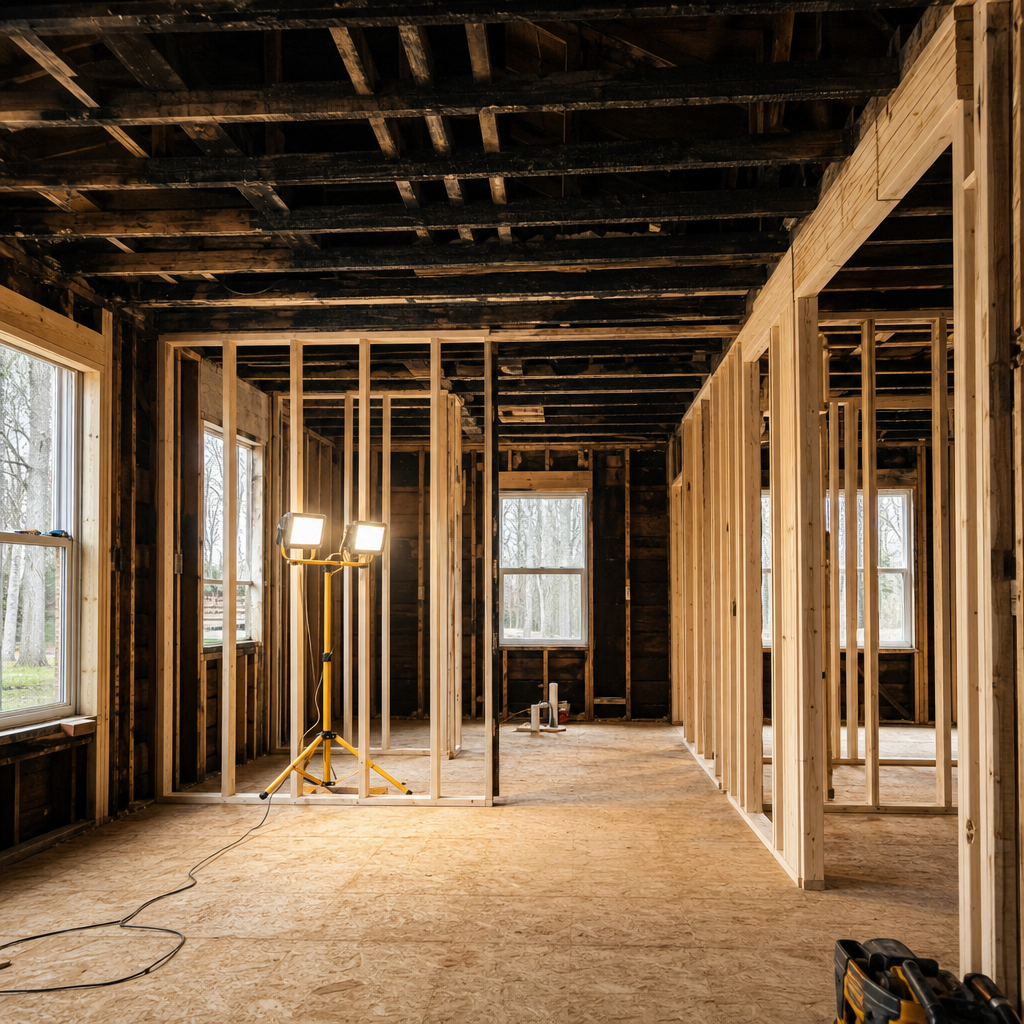
Managing Concealed Damage in Framing and Assemblies
According to NFPA U.S. home-fire data for 2019-2023, one- and two-family homes accounted for the majority of residential fire property damage. In these structures, heat and smoke can penetrate concealed spaces.[3]
Professionals inspect framing, ceilings, and subflooring to evaluate material integrity:
- Inspection: Assessing cavities and framing for hidden char, moisture, and soot penetration.
- Selective Removal: Discarding heavily charred, deteriorated, or waterlogged materials that cannot be safely restored.
- Surface Cleaning and Treatment: Cleaning structural timber and evaluating whether sealants are appropriate to address remaining surface residues based on professional assessment.
HVAC Systems, Insulation, and Odor Management
Soot and smoke can penetrate HVAC ductwork, porous insulation, and subflooring during a fire event.
Thorough physical cleaning and the removal of heavily contaminated materials remain the primary supported steps for odor management. Complete odor elimination cannot always be guaranteed, as results depend heavily on the depth of smoke penetration and the materials affected.
A variety of specialized deodorization methods-such as hydroxyl treatments, thermal fogging, ozone, chlorine dioxide, and encapsulating sealers-are sometimes used in the restoration industry. However, scientific evidence regarding the performance, comparative efficacy, and testing protocols for these treatments is inconsistent or still developing. The selection of any specific treatment depends on the materials involved, contamination levels, safety conditions, and assessment by qualified professionals like Floodline Restoration Co.
Fire Damage Restoration Timeline
Need fire damage restoration?
We’re available now - call for a fast, free estimate.
The time required to complete fire damage restoration varies substantially. Project duration depends on the severity of structural damage, the extent of smoke, soot, and water contamination, safety requirements, and the time needed for insurer assessments and local building permits.
| Service Approach | Project Scope | Homeowner Considerations |
|---|---|---|
| Mitigation-Only Company | Board-up, water extraction, and debris tear-out. | Focuses on initial stabilization; structural rebuild requires separate contracting. |
| Separate Contractors | Mitigation crew handles cleanup, separate trade contractors handle rebuild. | Requires coordinating schedules and estimates between distinct companies. |
| Integrated Restoration Provider | Single company manages stabilization, cleaning, and reconstruction. | Coordinates mitigation and rebuild under a unified project scope. |
Salvaging Contents and Working with Insurance
Prompt attention helps prevent avoidable deterioration of personal belongings exposed to soot and moisture.
Contents Evaluation
Restoration professionals, including teams from Floodline Restoration Co., inventory salvageable items and determine appropriate cleaning methods. Depending on the material, items may undergo specialized dry or wet cleaning, electronic cleaning, or targeted deodorization. Treatment methods must be chosen based on the item’s material composition and the degree of contamination.
Insurance Claims and Documentation
When preparing an insurance claim, property owners should promptly notify their insurer, document all damage with clear notes and dated photos, and maintain records of all mitigation activities and communications. Obtaining detailed, written estimates assists in presenting a clear proof-of-loss to the claims adjuster.[2]
How to Choose a Fire Damage Restoration Contractor
Selecting a competent contractor helps ensure repairs are completed safely and in accordance with standard building practices. Consider the following steps when hiring a provider:
- Confirm Qualifications: Check for relevant industry credentials and certifications in fire, smoke, and water damage restoration.
- Request Written Estimates: Insist on clear, itemized written scopes of work detailing cleaning, drying, and structural repairs.
- Document Damage Thoroughly: Work with contractors who provide clear photographic and written documentation of all affected areas.
- Notify Insurer Promptly: Coordinate directly with your insurance representative regarding policy requirements, estimates, and authorized repair scopes.
Frequently Asked Questions About Fire Damage Restoration
- How much does fire damage restoration cost? Costs depend on the extent of structural burning, soot distribution, water damage, and the specific materials needing repair or replacement. A comprehensive on-site assessment and written estimate are necessary to determine total project costs.
- Does homeowners insurance cover fire and smoke damage cleanup? Standard homeowners insurance policies may cover damage caused by fire, smoke, and firefighting-related water damage, as well as additional living expenses (ALE) if the home is uninhabitable. Coverage is subject to specific policy terms, deductibles, exclusions, coverage limits, valuation methods, and proof-of-loss requirements.
- Can smoke odor always be completely eliminated from a house? Complete odor elimination cannot be guaranteed in every situation. Thorough physical cleaning and the removal of heavily damaged materials are the primary supported steps. While treatments like thermal fogging, ozone, hydroxyl, and sealants are used in the industry, evidence regarding their effectiveness is inconsistent, and treatment selection depends on professional evaluation of the specific materials and damage.
- Can electronics and personal belongings be saved after a fire? Many contents and electronics can be restored depending on the severity of heat exposure, soot acidity, and moisture contact. A qualified professional, such as an expert at Floodline Restoration Co., evaluates the items to determine whether cleaning and restoration are feasible and cost-effective.
- What is the difference between fire mitigation and structural reconstruction? Fire mitigation focuses on emergency stabilization, including boarding up openings, extracting firefighting water, and removing contaminated debris and soot. Structural reconstruction involves the subsequent repair and rebuilding of structural framing, utilities, drywall, and interior finishes.
Need fire damage restoration?
We’re available now - call for a fast, free estimate.
Sources
- Statistics – USFA.FEMA.gov – usfa.fema.gov (2024)
- Residential fire estimate summaries (2014-2023) – USFA.FEMA.gov – usfa.fema.gov (2024)
- Residential fire estimate summaries (2014-2023) – USFA.FEMA.gov – usfa.fema.gov (2023)
- Residential fire estimate summaries (2014-2023) – usfa.fema.gov (2023)
- Statistical Reports on the Fire Problem in the United States – usfa.fema.gov (2020)
Related reading: Flood Restoration Near Me | 10% Off & Free Estimate | Same-Day Service
Related reading: Water Damage Restoration Service | 10% Off & Free Estimate | Same-Day Service
Related reading: Water Damage Restoration Companies Near Me | 10% Off & Free Estimate | Same-Day Service
Frequently Asked Questions
How quickly should fire damage restoration begin after the property is cleared by authorities?
Restoration should start immediately after official clearance because acidic soot residues and firefighting water begin causing irreversible surface etching, corrosion, and mold within 24 to 48 hours. Floodline Restoration Co. provides 24/7 live dispatch to deliver rapid emergency board-up, water extraction, and a free visual inspection.
What is the advantage of using an integrated fire restoration provider over separate contractors?
An integrated provider handles the entire recovery process under a single project scope, avoiding the delays, scheduling conflicts, and split liability common with separate cleanup and rebuild crews. Floodline Restoration Co. manages the entire transition in Queens from initial thermal soot mitigation to full structural reconstruction without third-party handoffs.
How is hidden smoke damage detected and treated in shared walls and framing assemblies?
Restoration technicians inspect wall cavities, floor joist pockets, and shared party walls using specialized tools to locate trapped soot, char, and moisture that cause recurring odors. Floodline Restoration Co. performs targeted opening, selective material removal, and surface encapsulation to permanently neutralize hidden contaminants without excessive structural disruption.
About the author
 |
Sarah Jenkins Sarah Jenkins is a certified restoration specialist with over eight years of experience managing water and fire damage recovery projects in the New York metropolitan area. Holding an IICRC certification in Applied Structural Drying, she bridges the gap between technical mitigation and insurance claim processes. Her writing focuses on practical, step-by-step guidance to help property owners navigate the complexities of disaster recovery. |
Water damage, flood, or mold emergency?
We’re available now - call for a fast, free estimate.
Call Now - Free Estimate