
Emergency Water Damage Restoration Near Me: What Glendale Homeowners Should Do First
If you have water coming into your Glendale home right now, the correct first step is to stop the source if you can do so safely, then call a restoration company that answers with a live person at (845) 482-0653. The first 90 minutes after water enters determine whether you’re looking at a $4,000 dry-out or a $14,000 tear-out, because water moves fast through wall cavities and under flooring long before you see it. If you’d rather not manage this yourself, call Floodline Restoration Co. now and a certified crew will be on the way while you read the rest of this.
Most emergency guides say “call a professional immediately.” That’s true and we’ll get to that. But while you’re waiting for the crew to arrive, two things you do and one thing almost everyone does that they shouldn’t will directly affect how much of your home we can save.
The First 90 Minutes: Three Decisions That Contain the Damage
The water itself causes less long-term damage than the decisions made in the first hour and a half. Here’s what actually moves the needle.
1. Confirm the Source Is Actually Stopped
A shut valve that’s still weeping is not a stopped source. In Glendale homes built before 1960, the shutoff valves under sinks and behind toilets are often original. They may not fully seat after decades of mineral buildup. We’ve arrived at homes on Cooper Avenue where the homeowner turned the valve clockwise until it stopped, the supply line looked dry, and thirty minutes later water was still trickling through the wall into the next room.
Take thirty seconds to look at the meter or listen at the wall before you assume it’s done. If you can’t confirm the source is stopped, shut off the main water line at the street or in the basement and call us from there. A live dispatcher answers 24/7 and will walk you through confirming the shutoff over the phone.
2. Isolate the Room, Not Just the Puddle
Water damage spreads by humidity even when the standing water is contained. The air in the affected room becomes saturated within the first hour, and that moisture travels under doors and through return air vents into rooms that were never wet. The fix is simple: close the doors to the affected room and any adjacent hallway, and if your HVAC is running, turn it off.
One Glendale homeowner on 69th Place closed the door to her flooded kitchen but left the central air running. The return ducts pulled humid air from the kitchen through the entire house. What started as a single-room extraction became a whole-home dry-out with air scrubbers running in three bedrooms that never saw a drop of water. Twenty seconds of turning off the thermostat would have prevented most of that.
3. Document Before You Move Anything
The single most valuable documentation step for your insurance claim happens before you move a single item. Take thirty seconds and walk the perimeter of the affected area with your phone camera. Capture wide shots of the standing water, then close shots of where the water meets walls, baseboards, and door casing. Insurance carriers look for the water line, the fill height, and what materials were in contact.
We bill insurance carriers directly and have handled thousands of these claims. The homeowners who take clear photos before cleanup starts consistently settle faster and with less back-and-forth. The photos establish the category of water and the extent at the moment of loss. That’s the line the water left, and it’s where we start.
What Not to Do: The Household Fan Mistake
Almost every homeowner we meet during an emergency wants to point a fan at the water to “help it dry.” We understand the instinct. It’s also the most common action that makes the damage worse.
A household box fan or floor fan does two things when pointed at standing water. First, it blows the water outward, spreading it across a larger surface area and forcing it deeper into gaps, cracks, and the space between flooring and subfloor. Second, it aerosolizes whatever is in the water. If the water came from a clean supply line, this just means more moisture in places you didn’t intend. If the water came from a dishwasher, a washing machine overflow, or a backed-up drain, you’re now circulating bacteria, soap residue, and organic matter through the air.
In water damage restoration, we classify water in three categories. Category 1 water is clean, from a supply line or an overflowing sink. Category 2 water contains significant contamination, from appliances or a sump pit. Category 3 water is grossly contaminated from sewage or outside flooding. A household fan pointed at Category 1 water that’s been sitting for a few hours can spread the conditions that move that Category 1 to Category 2 faster than it would on its own. In Glendale, where many homes have had the same dishwashers and washing machines in place for fifteen years, that standing water picks up residue from the appliance itself and the surrounding materials.
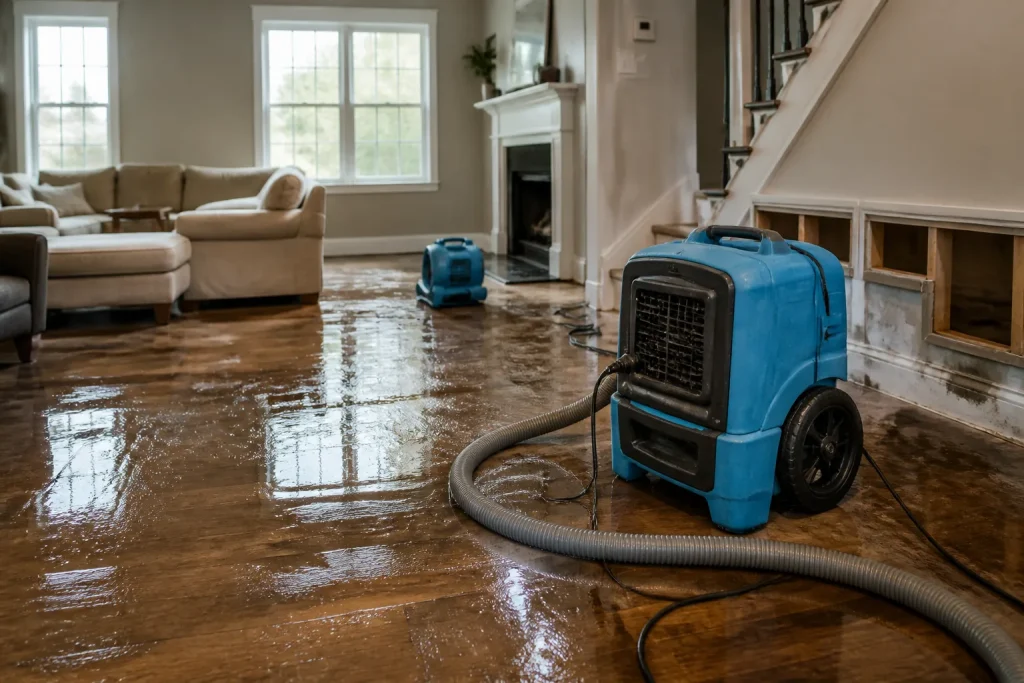
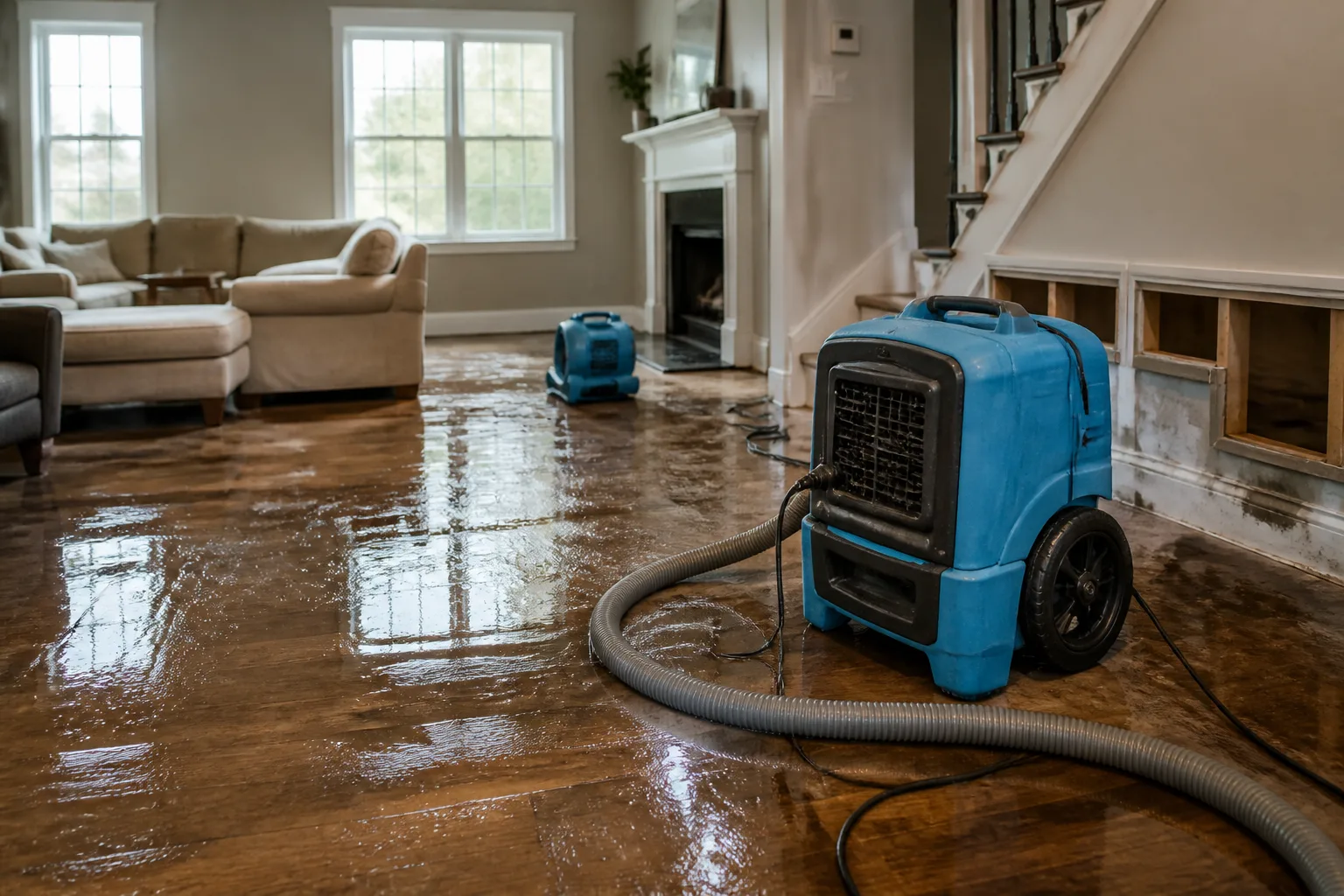
Leave the fans off. Leave the standing water alone. Extraction equipment and air movers placed by a trained technician are different tools used a different way. A professional-grade air mover from Dri-Eaz moves air in a specific pattern calculated from moisture meter readings. It’s not the same as a box fan from the basement.
What to Listen For When You Call at 2 A.M.
When water comes in at two in the morning, you’re going to call someone. The question to listen for in that call is whether you’re talking to a restoration company or a referral service. Most of the national call centers in this industry don’t dispatch a crew. They take your information and sell the lead to whoever’s on rotation, and you’ll wait longer and pay more for the privilege.
A qualified restoration dispatcher should ask you at least three things before they quote an arrival time. They should ask for the source of the water, whether it’s clean or contaminated, and what materials are affected. If they ask those questions, they’re building the scope of the response. If they ask three questions and quote you a price on the phone, it’s not a restoration company. It’s a sales operation.
Call us at (845) 482-0653 at any hour and you’ll get a live dispatcher. We’ve had someone on the phones through every storm, every burst pipe, every backed-up sewer in Glendale since 2010. The dispatcher will ask the right questions, dispatch a crew that’s already in the city, and stay on the line if you need help in the meantime.
Why Glendale Homes Need Sewage Protocol Confirmed Early
Glendale, Queens has a specific combination of factors that makes water damage escalate faster here than in newer suburbs. The housing stock on the blocks near Myrtle Avenue was built mostly between 1910 and 1940. Those homes have original sewer laterals, many of which are cast iron or clay pipe that has been in the ground for close to a century. The laterals crack, offset, and root-intrude over time. When a storm hits or a main line backs up, water comes into basements faster and dirtier than it would in a newer neighborhood.
The blocks near the Middle Village border share this infrastructure. We’ve completed sewage cleanup jobs on 71st Street and 66th Place where the water that came up through a floor drain had been in contact with a cracked lateral just a few feet below the slab. The water looked like dirty water, but it was Category 3 the moment it entered the home. That distinction matters because Category 3 water requires different containment, different personal protective equipment, and different disposal than Category 1. A homeowner who waits for the water to “go down” on its own with a lateral backup is letting black water soak into the concrete floor, the bottom plates of the walls, and anything stored on the floor.
If your Glendale basement has water coming up through a floor drain or a sump pit, tell the dispatcher. Say the words “sewer backup” or “floor drain.” That changes the protocol we send and the equipment we bring. It’s the difference between extraction and extraction plus containment.
What the First 15 Minutes of a Legitimate Assessment Looks Like
When our crew arrives at a Glendale home, the first thing we do is not move equipment. It’s take readings. If a restoration company walks in and immediately starts dropping fans and dehumidifiers, the crew doesn’t know what it’s dealing with.
A legitimate assessment starts with moisture meter readings. We take baseline readings on the affected materials and compare them against a dry standard. We check the moisture content of flooring, drywall, baseboards, and any material within four feet of the visible water line. Then we do a thermal imaging check to find water that isn’t visible, the water that’s traveled inside wall cavities or under a cabinet toe-kick. Professional-grade equipment like Dri-Eaz moisture meters and thermal imaging cameras show us where the water actually is, not just where it’s wet on the surface.
After the readings, you should hear a verbal scope summary. That’s the technician telling you what got wet, what needs to come out, what can be dried in place, and what the expected timeline is. The summary should be specific, not “we’ll dry it out.” You should hear specific rooms, specific materials, and a specific plan for the next 24 hours. That verbal summary is the beginning of the written moisture log you’ll receive. We hand that log to you and to your insurance carrier, with daily readings until the dry standard is met. That’s part of the 90-Day Done Right Promise, the Keystone Standard we put in writing on every job we do.
Water Damage Restoration in Glendale: What We Actually Do
Once the assessment is done, the work is methodical. Extraction comes first, with professional-grade XPOWER pumps and truck-mounted extractors where needed. Then containment goes up if the water is contaminated, using barriers and negative air pressure to keep contaminated air from moving into clean rooms. Then drying equipment goes in, placed according to the moisture map we built during the assessment, not according to guesswork.
We check moisture levels daily until the drying standard is reached. For most Glendale homes, that’s three to five days for a Category 1 supply line break, longer for a sewer backup or a flooded basement that’s been wet for hours before we arrived. The moisture log documents every reading, and we hand it to you and the carrier. The same crew that starts the job stays on the job, from first extraction to final rebuild if needed.
That matters more than most homeowners realize. A company that hands the dry-out to one crew, the demolition to another, and the rebuild to a third can leave you explaining the same water damage to three different sets of technicians. We built Floodline Restoration Co. around a dispatch board, not a sales desk, precisely so a Glendale homeowner never goes through that. If you’re dealing with water damage right now, call us before you call anyone else. If you’re reading this before anything has happened, bookmark the number, and if you want to know more about what we do, start with our Water Damage Restoration in Glendale page.
When to Call a Pro
You can handle a small supply line leak under a sink if you catch it immediately, and the water hasn’t traveled, and you can dry the space thoroughly with household tools. The moment water is on drywall, under flooring, or in contact with any porous material for more than an hour, you’re past the point of DIY drying. If you smell anything musty within days of the incident, water is trapped where you can’t see it, and mold growth has already started.
If you’re reading this with water in your home right now, put this down and call (845) 482-0653. We’re local to Glendale, we answer live at every hour, and we’ll have a certified crew at your door today.
The Bottom Line
The first 90 minutes after water enters your Glendale home determine the cost of the job more than anything else. Stop the source completely, isolate the affected room, document the water line before you move anything, and do not put a household fan on standing water. When you call a restoration company, listen for the questions a real dispatcher asks. If you hear a sales pitch instead of a scope, you called the wrong number.
Floodline Restoration Co. has served Glendale since 2010 with a live dispatcher on every call, background-checked and uniformed technicians trained to IICRC, RIA, and IFA standards, and a 90-Day Done Right Promise in writing on every job. If you need help right now, call (845) 482-0653 for a free estimate, and a certified crew will be on the way. Current offers include $50 Off Any Repair Over $250, the $89 Seasonal Tune-Up, and a Senior & Veteran 5% Discount always in effect. We’ll be there when we say.
Frequently Asked Questions
How fast can someone actually get to my Glendale home?
If you call Floodline Restoration Co. at (845) 482-0653, a live dispatcher answers immediately and a certified crew from our Glendale operation is dispatched the same call. Most jobs in Glendale see extraction running the same visit.
Do I really need full restoration or just a cleaning?
That depends on where the water went. If water is on drywall, under flooring, or inside a wall cavity, cleaning the surface doesn’t address what’s trapped. A moisture meter tells us whether drying in place is possible or whether materials need removal. The assessment determines the scope, and you’ll hear that scope verbally before we start any work.
Will my insurance cover the water damage?
Most homeowner policies cover sudden and accidental water damage from a burst pipe or appliance, but coverage varies by your specific policy. We bill insurance carriers directly, document every reading in a moisture log, and coordinate with your adjuster so you’re not the messenger. Take photos before cleanup starts, and we’ll help with the documentation from there.
How much does emergency water damage restoration cost in Glendale?
Costs depend on the category of water, the square footage affected, and how far the water traveled. A single-room Category 1 extraction and dry-out in Glendale typically runs lower than a basement sewage backup requiring containment and disposal. Your exact quote comes after the assessment, with a written scope before work starts. Call (845) 482-0653 for a free estimate.
Written by Curt Bowman, Owner at Floodline Restoration Co., serving Glendale since 2010.
Need Damage Restoration Help?
Call Floodline Restoration Co. - licensed & insured, here with fast after-hours help in Glendale.
(845) 482-0653