
Quick Summary
Managing fire restoration damage requires rapid intervention to mitigate complex secondary risks involving water saturation, toxic soot migration, and compromised building assemblies. Floodline Restoration Co. provides full-service emergency fire and smoke recovery tailored to Queens architectural styles, expertly handling everything from immediate board-up and water extraction to structural soot removal, air scrubbing, full reconstruction, and seamless insurance documentation. Property owners will understand each phase of the recovery timeline and can protect their investment by calling Floodline Restoration Co.'s 24/7 dispatch line for rapid on-site response and a free, upfront visual inspection.
Fire Restoration Damage: Rapid 24/7 Recovery Guide
Dealing with fire restoration damage is one of the most overwhelming challenges a property owner can face. Beyond the charred surfaces you can see, a building fire triggers a complex chain reaction of soot deposition, smoke migration, and water saturation from suppression efforts. According to the U.S. Fire Administration, national fire-related dollar losses reached approximately $19.086 billion in 2024. The average U.S. fire department responded to a fire call roughly every 23 seconds. While residential and home fires accounted for roughly one-quarter of reported U.S. fires in 2024, home-property fires caused approximately 75% of civilian fire deaths and injuries in 2024. Additionally, California wildfires accounted for an estimated $550 million of the approximately $19.1 billion in U.S. direct fire property losses in 2024, with significant destruction occurring inside residential homes and commercial buildings.[1]
When the first responders leave, prompt mitigation is essential. Standing water, soot residues, and smoke penetration into porous building assemblies can lead to secondary damage if unaddressed. According to specialists at Floodline Restoration Co., knowing what steps to take, what restoration costs to expect, and how the physical cleanup process works will help you protect your property and navigate insurance claims without costly delays.[2]
Fire Restoration Damage: Emergency Response and What to Expect
The initial period after a fire often determines whether structural elements, personal belongings, and interior finishes can be restored or will require replacement. A dependable emergency response does not start with demolition; it starts with stabilizing the environment to prevent secondary destruction.
Emergency restoration teams typically prioritize making the structure safe and weather-tight upon arrival. Firefighters often have to break windows, cut inspection holes in roofs, and breach doors to vent heat and locate hidden flames. Boarding up these openings prevents weather intrusion, vandalism, and unauthorized entry while technicians assess structural stability.
At the same time, emergency crews must tackle standing water. Fire suppression water pools on subfloors, seeps into ceiling cavities, and migrates down into lower levels. Water extraction and structural dehumidification are typically initiated alongside soot remediation to reduce the risk of secondary microbial growth and material deterioration.
Key Priorities in Early Response
- Site Stabilization and Board-Up: Securing broken windows, exterior door breaches, and compromised roof sections with tarps and plywood.
- Water Extraction and Drying: Pumping out standing suppression water, removing saturated carpet padding, and placing dehumidification equipment to draw moisture out of structural materials.
- Corrosion Control: Wiping down polished metals, fixtures, and glass surfaces to mitigate potential staining and surface etching from soot deposits.
- Detailed Photographic Inventory: Documenting every affected room, structural component, and damaged item before anything is moved or discarded, establishing clear proof for your insurance adjuster.
What Does Fire Restoration Damage Cost?
Need fire restoration damage?
We’re available now - call for a fast, free estimate.
According to estimates from Fixr, fire damage restoration costs average approximately $11,900, with typical residential projects ranging between $3,000 and $40,000. Actual costs vary significantly depending on the severity of the fire, the extent of smoke and soot contamination, water damage, the size of affected areas, and structural reconstruction needs. Large-scale structural rebuilds involving heavy framing replacement and full reconstruction can exceed these ranges.[3]
Restoration pricing is determined by several distinct variables rather than square footage alone:
- Type of Soot: Different soot residues (such as dry soot from fast-burning wood, synthetic soot from plastics, or greasy soot from kitchen fires) require distinct cleaning procedures.
- Water Saturation: The volume of water left behind by firefighting efforts dictating the amount of drying equipment, drying time, and moisture mapping required.
- Structural Scope: The degree of damage to load-bearing framing, subflooring, and interior assemblies requiring repair or replacement.
- Air Quality and Duct Remediation: The extent of mechanical duct cleaning and deodorization required to address embedded residues.
Navigating Homeowners Insurance
Homeowners insurance coverage commonly applies to fire damage repair, smoke remediation, and associated firefighting water damage when fire is a covered peril. However, total payout is subject to specific policy terms, deductibles, exclusions, coverage limits, and the policy’s valuation method (such as Replacement Cost Value or Actual Cash Value). To protect your claim, work with qualified restoration professionals like Floodline Restoration Co. who provide detailed, line-item photographic documentation directly to your carrier.[4]
Restoring Structural Framing and Building Assemblies
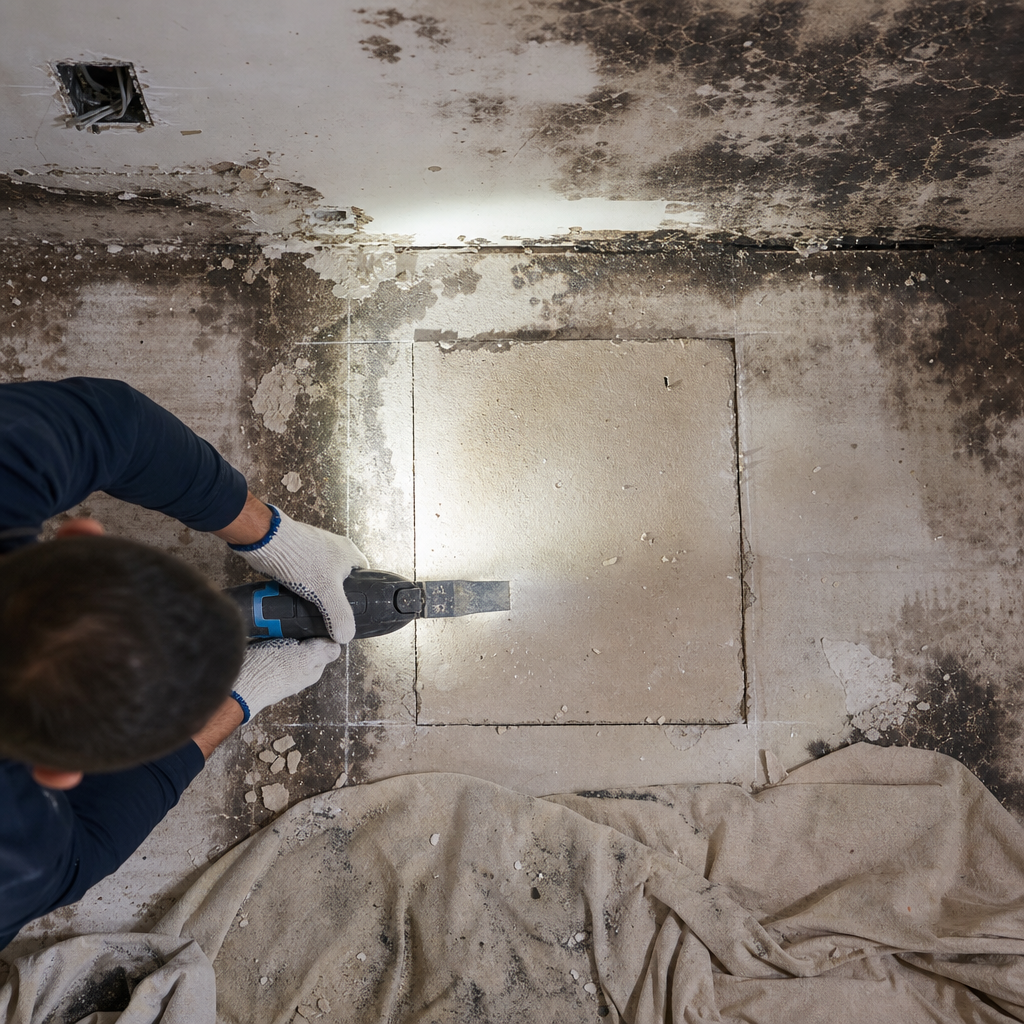
In multi-unit or attached buildings as well as standalone structures, smoke, soot, and moisture can migrate into wall cavities, subfloors, and structural framing.
Remediation involves thoroughly inspecting structural components for fire, smoke, and moisture damage. Technicians evaluate framing members, subflooring, and adjoining wall assemblies, removing unsalvageable materials where necessary, drying wet assemblies, and preparing surfaces for cleaning and reconstruction.
Treating Fire-Damaged Drywall, Ceilings, and Wall Finishes
Need fire restoration damage?
We’re available now - call for a fast, free estimate.
Different wall and ceiling materials respond differently to heat, smoke, and suppression water, requiring tailored restoration strategies:
Drywall Assemblies
Drywall exposed to light or moderate surface smoke can often be cleaned and sealed. However, when drywall sustains direct flame contact, structural weakening, or substantial water saturation, the damaged sections must be cut out and replaced.
Plaster Assemblies
Plaster can be resilient against minor surface smoke, but prolonged water exposure or structural movement can weaken its bond to the substrate. Technicians evaluate plaster surfaces for stability, cleaning intact areas and removing compromised sections where structural integrity has been lost.
Decontaminating HVAC Ducts, Attic Spaces, and Contents
When a fire occurs, air currents can pull smoke and soot into return air vents, attics, and ceiling plenums. If the HVAC system operates during or after the fire, it can distribute particulates throughout the building.
Eliminating Deep Smoke and Soot Odors
As emphasized by Floodline Restoration Co., effective deodorization requires that physical source removal and thorough cleaning of soot residues precede any secondary odor treatments. While various deodorization methods are utilized in the industry, the scientific evidence and safety protocols for treatments such as ozone, hydroxyl generators, chlorine dioxide, thermal fogging, sealants, and associated laboratory testing remain incomplete or inconsistent.
- Source Removal and Cleaning: Physically cleaning all soot and smoke residues from accessible structural surfaces, ductwork, and structural cavities prior to deodorization.
- Air Filtration: Operating commercial air filtration devices equipped with HEPA and carbon filters to capture suspended particulate matter.
- Odor Countermeasures and Sealing: Applying targeted odor treatments or surface sealants to framing and subfloors as appropriate once thorough cleaning has occurred.
Assessing Salvageability of Contents
Determining whether personal belongings, furnishings, and equipment can be restored requires a case-by-case evaluation based on the specific material, degree of soot contamination, heat exposure, water damage, safety considerations, and professional restoration assessment.
| Material Category | Damage Assessment Factors | Restoration Evaluation |
|---|---|---|
| Hard / Non-Porous (Metal, glass, finished hardwood) | Surface soot deposition, heat exposure, and finish condition. | Evaluated case by case for specialized surface cleaning, polishing, or refinishing depending on heat and chemical damage. |
| Porous Textiles (Upholstery, clothing, drapes) | Smoke penetration, soot staining, fiber integrity, and water exposure. | Evaluated individually for professional dry cleaning, specialized laundering, or replacement if heavily degraded or contaminated. |
| Electronics & Appliances | Internal particulate accumulation, heat exposure, and water contact. | Requires professional technical inspection and safety testing before determining repairability or need for replacement. |
| Consumables & Porous Items (Food, cosmetics, porous soft goods) | Potential contamination from combustion byproducts, heat, and smoke. | Typically evaluated for disposal due to health, safety, and hygiene risks, and documented for insurance claims. |
Frequently Asked Questions About Fire Restoration Damage
How much does fire damage restoration cost on average?
According to Fixr estimates, typical residential fire restoration projects cost between $3,000 and $40,000, with an average around $11,900. Actual costs vary widely depending on the severity of the fire, the extent of smoke and soot contamination, water damage, the size of affected areas, and structural reconstruction needs.
What are the main steps in the fire restoration process?
The standard restoration process typically follows several core phases: emergency board-up and site stabilization, standing water extraction and structural drying, source removal and soot residue cleaning, deodorization and air filtration, structural repairs, and final reconstruction of interior finishes.
How long does it take to clean and restore a house after a fire?
According to Floodline Restoration Co., restoration timelines depend on the severity of the incident. Minor damage may take several weeks to clean and repair, while extensive reconstruction can take many months. In major post-disaster rebuilding scenarios, the process can take at least 18 to 24 months.
Does homeowners insurance cover professional fire damage repair?
Homeowners insurance commonly covers fire, smoke, and firefighting water damage when fire is a covered peril. Total coverage is subject to specific policy terms, deductibles, exclusions, limits, and the applicable valuation method (such as Replacement Cost Value or Actual Cash Value).[5]
How do restoration companies remove deep smoke and soot odor?
Restoration teams prioritize thorough source removal and physical cleaning of soot residues from all accessible surfaces before applying secondary odor treatments. While methods like air filtration, specialized odor counteractants, and surface sealants may be used, protocols and evidence regarding specific chemical and gaseous treatments remain variable, making physical cleaning the essential first step.
What items can be salvaged after smoke and fire damage?
Salvageability must be assessed on a case-by-case basis depending on material porosity, degree of contamination, heat exposure, water damage, and health and safety considerations. Professional evaluation determines whether items can be restored through specialized cleaning or should be documented for replacement.
Need fire restoration damage?
We’re available now - call for a fast, free estimate.
Sources
- Statistics – USFA.FEMA.gov – usfa.fema.gov (2024)
- Residential fire estimate summaries (2014-2023) – USFA.FEMA.gov – usfa.fema.gov (2024)
- Residential building fire dollar-loss causes (2014-2023) – usfa.fema.gov (2024)
- Statistical Reports on Who Fire Impacts – USFA.FEMA.gov – usfa.fema.gov
- Fire loss in the United States | NFPA Research – nfpa.org (2024)
Related reading: Fire Damage and Restoration – Call Now-10% Off – Same-Day Service – Free Estimate
Related reading: Flood Restoration Near Me | 10% Off & Free Estimate | Same-Day Service
Related reading: Water Damage Restoration Service | 10% Off & Free Estimate | Same-Day Service
Frequently Asked Questions
Is it safe to enter my home and clean up soot myself after a fire?
Entering a fire-damaged property without professional clearance exposes you to serious hazards, including weakened structural assemblies, hidden electrical risks, and toxic particulate inhalation. Attempting DIY soot removal often drives acidic residues deeper into porous surfaces or causes permanent staining on fixtures. Floodline Restoration Co. offers 24/7 emergency dispatch and a free, upfront visual inspection to evaluate structural safety and initiate professional mitigation.
How quickly does secondary water and soot damage begin after a fire?
Secondary destruction begins within minutes to hours, as acidic soot residue etches glass, discolors plastics, and corrodes metal fixtures. Simultaneously, suppression water left in subfloors and wall cavities can trigger microbial growth and structural warping within 24 to 48 hours. Floodline Restoration Co. deploys rapid-response crews to perform immediate water extraction, corrosion control, and structural drying to halt progressive damage.
How does Floodline Restoration Co. assist with homeowners insurance claims?
Floodline Restoration Co. streamlines the claims process by compiling exhaustive, line-item photographic documentation and moisture-mapping logs directly for your insurance adjuster. Their technicians specialize in navigating complex policy requirements for both structural rebuilds and content remediation, ensuring all fire, smoke, and water damage is accurately accounted for. This seamless coordination eliminates coverage disputes and prevents costly repair delays.
About the author
 |
Sarah Jenkins Sarah Jenkins is a certified restoration specialist with over eight years of experience managing water and fire damage recovery projects in the New York metropolitan area. Holding an IICRC certification in Applied Structural Drying, she bridges the gap between technical mitigation and insurance claim processes. Her writing focuses on practical, step-by-step guidance to help property owners navigate the complexities of disaster recovery. |
Water damage, flood, or mold emergency?
We’re available now - call for a fast, free estimate.
Call Now - Free Estimate