
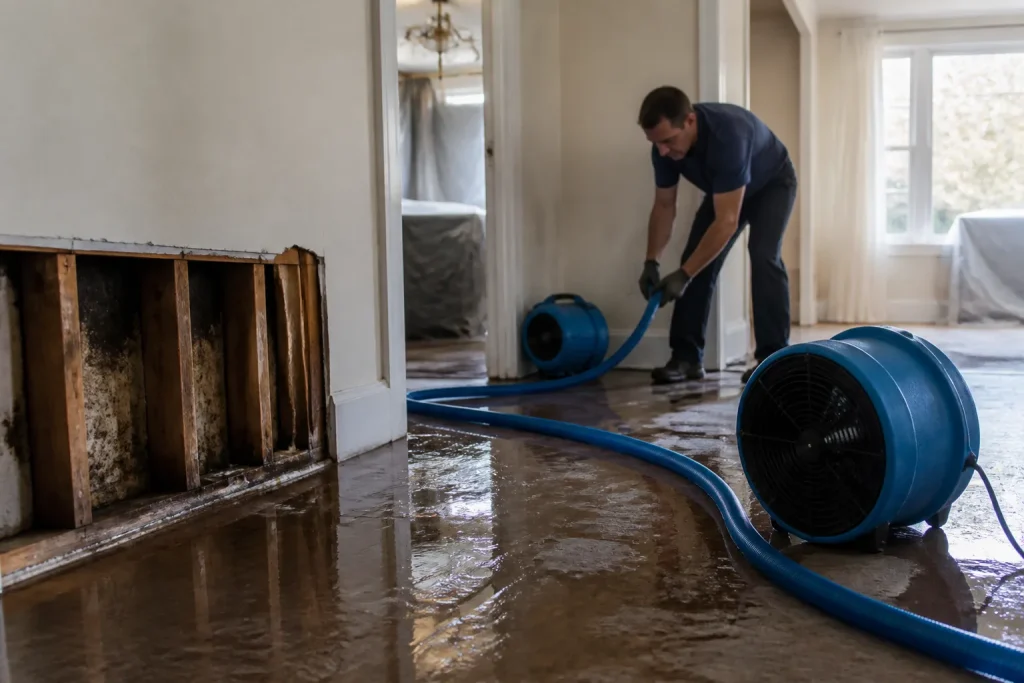
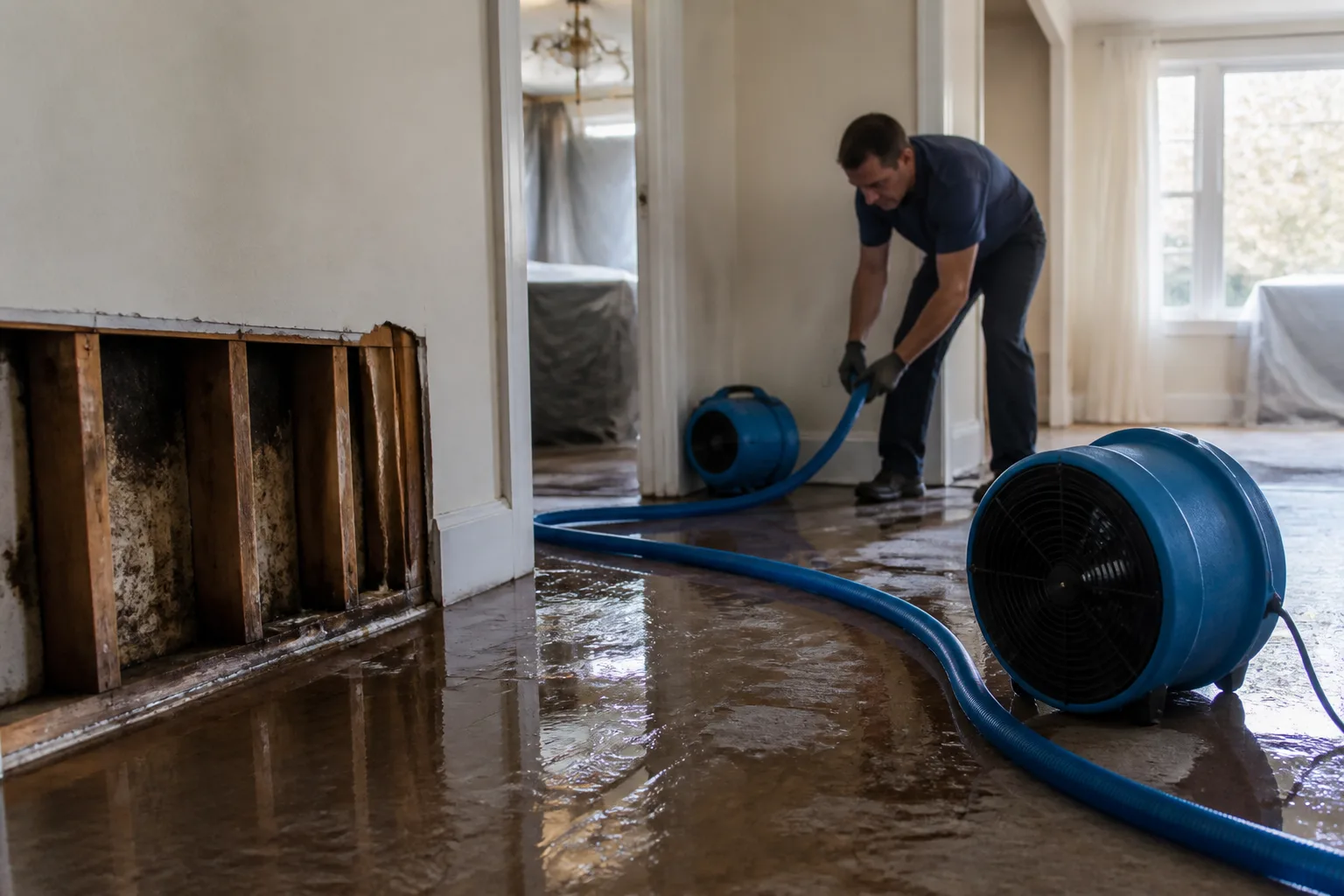
Water Damage Restoration Cost Guide: What Glendale Homeowners Pay in 2026
Water damage restoration in Glendale, NY typically runs $2,800 for a small appliance leak up to $18,000+ for a finished-basement sewage backup, with most homeowners landing between $5,500 and $12,500 in 2026. The national averages you see online don’t reflect Glendale’s housing stock or the way Queens-county carriers price claims. If you’d rather skip the research and get a straight number, call (845) 482-0653 for a free estimate.
Here’s the number most guides won’t tell you: a finished basement with a sewage backup in Glendale, NY routinely runs $11,000 to $18,000 before rebuild. Category 3 water means full biohazard protocol, and that line item alone changes everything. We’ve pulled sewage water out of basements on 73rd Place and Myrtle Avenue enough times to know exactly what the carriers push back on and what the final bills actually look like.
Key Takeaways
- Clean water (supply line, appliance): $2,800-$5,500 in Glendale
- Gray water (washing machine overflow, dishwasher): $4,000-$8,000
- Black water (sewage backup): $8,500-$18,000+ before rebuild
- Split-contractor jobs cost 20-35% more than single-crew restoration
- Direct insurance billing works, but only if you confirm the terms in writing first
What Water Damage Actually Costs in Glendale, by Water Category
Restoration companies classify water into three categories, and the category determines the entire bill. Glendale’s older housing stock, much of it built before 1960 with original cast-iron waste lines, means we see more Category 2 and 3 losses than newer neighborhoods do. Here’s what each tier runs in this specific market.
Category 1: Clean Water ($2,800-$5,500)
This is water from a supply line, a burst pipe, or an overflowing bathtub. It’s the cheapest to remediate because there’s no contamination. In Glendale, a typical Category 1 loss in an unfinished basement runs about $2,800 to $5,500, which includes extraction, drying, and basic repairs. We’ve handled supply-line failures on Cooper Avenue where the total bill came in under $3,000 because the homeowner caught it the same day. Speed matters here because clean water becomes gray water within 48 to 72 hours if left sitting.
Category 2: Gray Water ($4,000-$8,000)
Gray water contains significant contaminants, usually from washing machine overflows, dishwasher discharge, or sump pump failures. These losses require antimicrobial treatments and more aggressive drying. Expect $4,000 to $8,000 in Glendale, with the higher end involving finished basements where baseboards, drywall, and carpet pad all come out. The old row houses near St. John’s Cemetery and along Woodhaven Boulevard have shallow basement floors, so water pools fast and wicks up drywall quicker than in newer construction with better drainage.
Category 3: Black Water ($8,500-$18,000+)
This is sewage, and it’s the most expensive line item in Glendale restoration for a reason. Category 3 water carries pathogens that require full biohazard protocol: containment barriers, negative air pressure, HEPA filtration, and complete removal of porous materials. A finished basement with a sewage backup near the Jamaica Bay drainage corridor typically lands between $11,000 and $18,000 before any rebuild work begins. The carriers know this. It’s not a number we pull out of the air; it’s what the scopes actually come to by the time containment, disposal, sanitation, and drying are done right.
What Queens-County Insurance Carriers Actually Flag
Here’s what most cost guides miss: your restoration bill isn’t just a function of the damage. It’s a function of what your carrier agrees to pay, and Queens-county adjusters have developed specific habits. We’ve sat across from enough of them to know what they scrutinize.
- Moisture readings taken before demotion. If the initial moisture map isn’t documented with photo evidence and equipment-level readings, expect the carrier to dispute the scope.
- Daily drying logs. Adjusters want to see that equipment stayed in place until the dry standard was met, not pulled early to save money. A certified moisture log, with daily readings from Dri-Eaz or Phoenix equipment, is the single best defense against a disputed claim.
- Category classification documentation. If you had sewage backup, the adjuster needs a written classification of Category 3 water with the reasoning. Without it, they’ll process the claim as gray water, and you’ll eat the difference.
- Contents inventory with photos. Anything you claim as damaged personal property needs to be photographed, logged, and tied to the loss. Carriers in this market are aggressively denying undocumented contents claims.
This is where having a crew that hands you and your carrier a written moisture log from day one makes real dollar difference. Not a verbal summary, not a text message. A written record that holds up when the adjuster asks for it.
The Hidden 20-35% Cost of Splitting Mitigation and Rebuild
This is the line item no generic cost guide warns Glendale homeowners about, and it’s the one that costs people the most in the long run. When you hire one company to extract and dry, then a separate contractor to do the rebuild, you are paying for two separate assessments, two separate project managers, and a gap in accountability between the two. Every one of those handoffs adds cost.
Here’s where it goes wrong. The mitigation crew dries the space and leaves. The rebuild contractor comes in, takes their own measurements, finds something the mitigation crew didn’t document, and now you’ve got a change order. Or the mitigation crew misses a moisture pocket behind a wall, the rebuild contractor covers it up, and six weeks later mold is growing behind new drywall. Now you’re paying for mold remediation in Glendale on top of everything else.
In our experience, the split-contractor model adds 20 to 35 percent to the total project cost through coordination delays, duplicate assessments, and the inevitable finger-pointing when something goes wrong. The full-cycle model, one crew from first extraction to finished rebuild, removes that entire line item. That’s how the team at Floodline Restoration Co. home works, and it’s why we track costs tighter than a two-contractor job ever could.
What “Direct Insurance Billing” Actually Means, In Writing
Direct insurance billing sounds simple, and it should be. The restoration company bills your carrier directly, and you don’t play messenger. But the term gets thrown around loosely in this industry, and Glendale homeowners should know exactly what to confirm before signing anything.
Here’s what to ask, in writing, before work starts:
- Does the company work directly with the adjuster, or just submit the bill and leave you to manage it? There’s a difference. Direct billing means the restoration company communicates with your carrier, provides the documentation the adjuster requests, and negotiates the scope on your behalf. If a company won’t put that in writing, walk.
- What happens if the carrier disputes a line item? Some companies bill the carrier and then send you the balance when the carrier pays less than the scope. You need to know that upfront, not when the check arrives.
- Who holds the written scope of work? You should have a copy, signed, with line-item pricing before anyone opens a wall. If a contractor won’t show you the scope, the bill isn’t going to be a square deal.
- Is there a no-surprises clause? This means the company eats the difference if they underbid their own scope. We put the Keystone Standard in writing on every job, and it includes exactly this: done right, and backed in writing.
We bill carrier-direct on every job, and the homeowner never plays messenger between us and the adjuster. That’s not a marketing line. It’s how the paperwork works, and it’s the only way insurance restoration should be done.
The 90-Day Callback Window and Why It Has Real Dollar Value
Most homeowners think the job ends when the crew packs up the fans. It doesn’t. The drying equipment comes out when the moisture readings hit the dry standard, but the structure needs time to settle. Hidden moisture pockets show up in the weeks after, not the days after. That’s why the 90-day window matters in dollars, not just in comfort.
Here’s the math. A botched dry-out means one mold remediation call. In Glendale, mold remediation in a finished basement runs $3,000 to $8,000 on its own, sometimes more if it’s behind finished walls. The original water job might have cost $6,000. The mold remediation costs more than the original job. That’s not an exaggeration; we’ve watched neighbors on 80th Street pay for a second restoration because the first company pulled the equipment two days early.
The 90-Day Done Right Promise, what we call the Keystone Standard, is our fix for that problem. If it’s not done right, we make it right, in writing, with no paperwork battles and no arguing. That guarantee has real dollar value because it means the company that dried the space is the same company that stands behind the result three months later. A company that won’t give you a written callback window is quietly betting you won’t notice the problem until after the warranty you never got would have expired.
One more thing about the dry-out itself: the equipment matters. We run Dri-Eaz dehumidifiers, Phoenix air movers, and the XPOWER and B-Air units on larger jobs. Injectidry systems handle the hard-to-reach areas like under cabinets and inside wall cavities that ordinary floor fans miss. A homeowner shouldn’t care about brand names, except that the carriers do. Adjusters recognize professional-grade equipment logs, and they process those claims faster.
When to Call a Pro (and When to Wait)
If you’ve got a slow drip under a sink and you catch it within a few hours, you might get away with drying the area yourself and watching it closely. But if water has touched drywall, insulation, or any finished surface, call before the 48-hour mark. That’s the window before clean water becomes gray water and the bill roughly doubles.
Call immediately for any of these Glendale-specific scenarios:
- Water rising in a finished basement, especially if you smell sewage. That’s Category 3, and every hour it sits means more material removed and a bigger scope.
- A supply line bursting while nobody’s home. That’s a flood, not a leak, and it’s actively spreading through the floor joists while you read this.
- Water anywhere near your electrical panel. The panel sits at basement level in most of the row houses, and water plus electricity is a life-safety issue, not a DIY moment.
- Any water intrusion after a heavy rain storm in the Jamaica Bay drainage corridor. Storm water carries contaminants and finds its way into basements through foundation cracks that never show up in dry weather.
If you’re dealing with any of these, call (845) 482-0653. A live dispatcher answers, not a recording, and a certified crew reaches the job the same visit. We’ve been doing this in Glendale since 2010, and the phone still rings to a person, 24/7.
Related Services in Glendale
If your water damage sits untreated for more than 48 hours, you’re likely looking at mold remediation in Glendale as the next call. If a kitchen fire or smoke event ever forces water into the mix, our fire and smoke damage restoration in Glendale crew handles the full scope. And for the complete picture on how we approach any water loss, start at our water damage restoration in Glendale page.
What happens when you call
- 1
A real person answersNo phone trees - you reach a local pro.
- 2
You get an upfront price rangeHonest numbers before anyone is dispatched.
- 3
A background-checked tech heads outLicensed & insured, dispatched right away.
- 4
You approve before work beginsNothing starts until you say go.
The Bottom Line
Glendale water damage restoration costs what it costs because the water category, the housing stock, and the carrier all have a say. Clean water is manageable. Gray water demands speed. Black water demands protocol, and protocol costs money. The national averages won’t prepare you for a sewage backup in a pre-war basement, and the split-contractor model quietly adds thousands to your total even when the estimates look comparable.
What actually keeps a water damage bill from spiraling is a written scope, a certified moisture log, direct carrier billing, and a company that stands behind the dry-out in writing. The 90-Day Done Right Promise is the difference between paying for a restoration once and paying for it twice. We don’t cut corners on drying, and we don’t hand you a bill that reads like a surprise.
If you’re in Glendale and need help, Floodline Restoration Co. offers free estimates. Call (845) 482-0653, and a live person answers. We’ll be there when we say.
Frequently Asked Questions
Water damage restoration in Glendale costs $2,800 to $5,500 for clean water losses, $4,000 to $8,000 for gray water, and $8,500 to $18,000+ for black water or sewage backups in finished basements. The average Glendale homeowner pays between $5,500 and $12,500 depending on water category and the extent of finish materials affected. Call (845) 482-0653 for an exact quote, estimates are free.
Most Glendale homeowners’ policies cover sudden and accidental water damage, like a burst supply line or appliance overflow. Gradual leaks, flooding from outside, and sewer backups often require specific endorsements. Your restoration company should provide photo documentation, moisture logs, and direct adjuster coordination to support the claim. Floodline Restoration Co. bills your carrier directly and handles the paperwork, so you never play messenger.
Same visit, in most cases. Floodline Restoration Co. runs live dispatch 24/7, so a real person answers at 2 a.m. the same way they do at noon. A certified crew reaches most Glendale addresses within hours, and extraction starts the same visit. Call (845) 482-0653 the moment you see standing water or smell sewage.
If water touched drywall, insulation, or finished flooring, full restoration is usually necessary. A fan pointed at the surface won’t reach moisture inside wall cavities, and that hidden water breeds mold within days. The cost of one mold remediation call often exceeds the cost of proper drying. Call (845) 482-0653 for an honest assessment, and we’ll tell you if the job really needs professional equipment or if you can handle it with a shop vac.
The 90-Day Done Right Promise, our Keystone Standard, is a written guarantee that if the restoration isn’t done right, we make it right within 90 days, with no paperwork battles and no arguing. It’s tied to our K.E.Y.S. values code: Krafted right, Every time, Your home first, Standing behind it. Every Floodline Restoration Co. job includes this guarantee in writing before work begins.
Written by Curt Bowman, Owner at Floodline Restoration Co., serving Glendale since 2010.
Need Damage Restoration Help?
Call Floodline Restoration Co. - licensed & insured, here with fast after-hours help in Glendale.
(845) 482-0653